immemoris
A home for the memories that make your story.
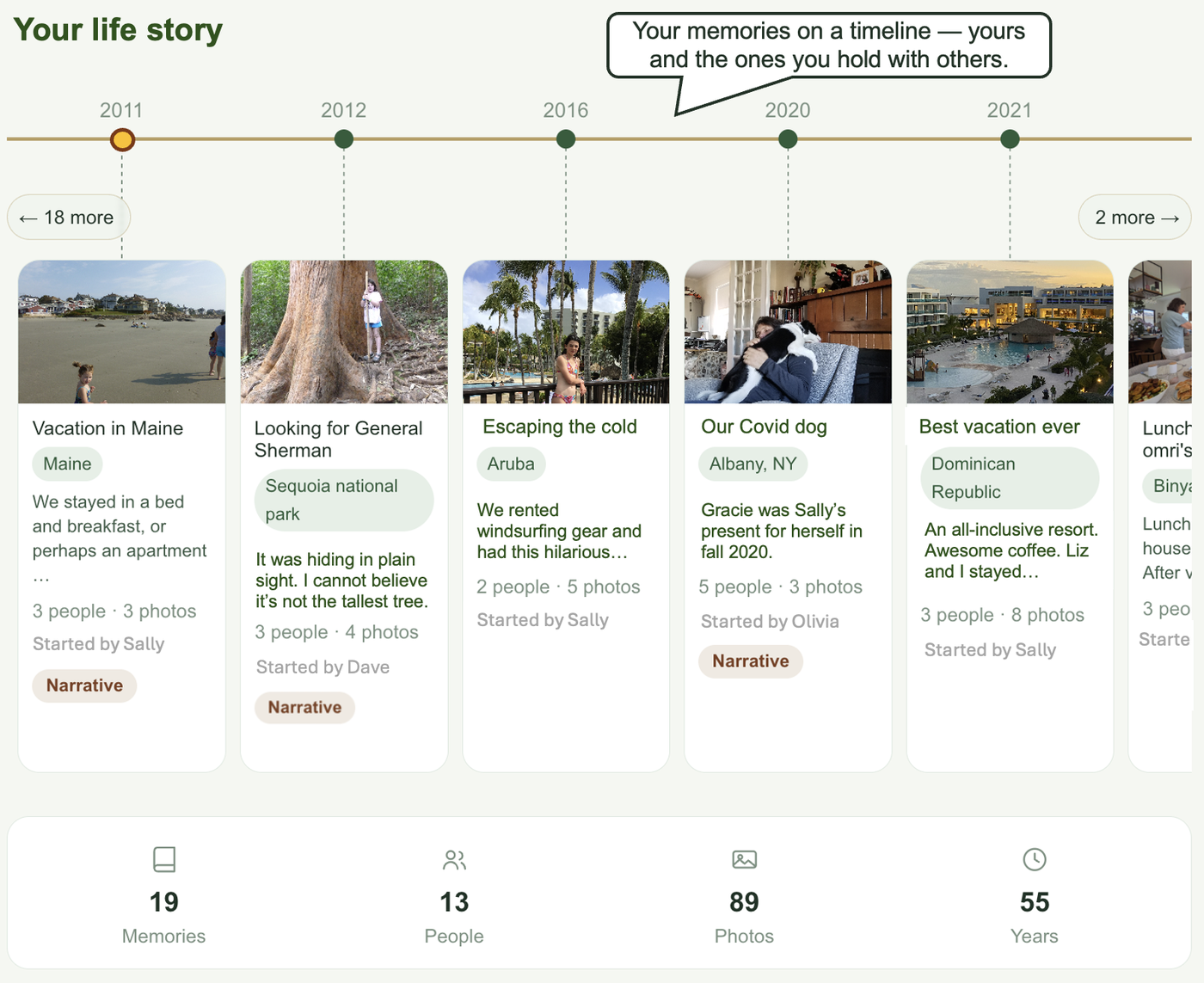
Memories of the people, places, and moments that made you — preserved as you remember them, or fuller through the people who were there.
Some memories are yours alone. Others belong to several people — you have one piece, someone else has another. Either way, immemoris helps you gather what's there and weave it together. What you end up with is a written memory fuller than the one in your head — yours to return to, add to, share, and pass on.
Start your first memoryWhy immemoris
Memory is rarely as complete as we think. We remember the feeling of an experience but forget the details — the name of the place, the year, what someone said that made everyone laugh. And over time, even what we keep fades.
How it works
01
Start with a fragment
A title, a date, a place — or just a photo. Even one detail is enough to begin. You don't need to remember the whole thing.
02
Remember more, with help
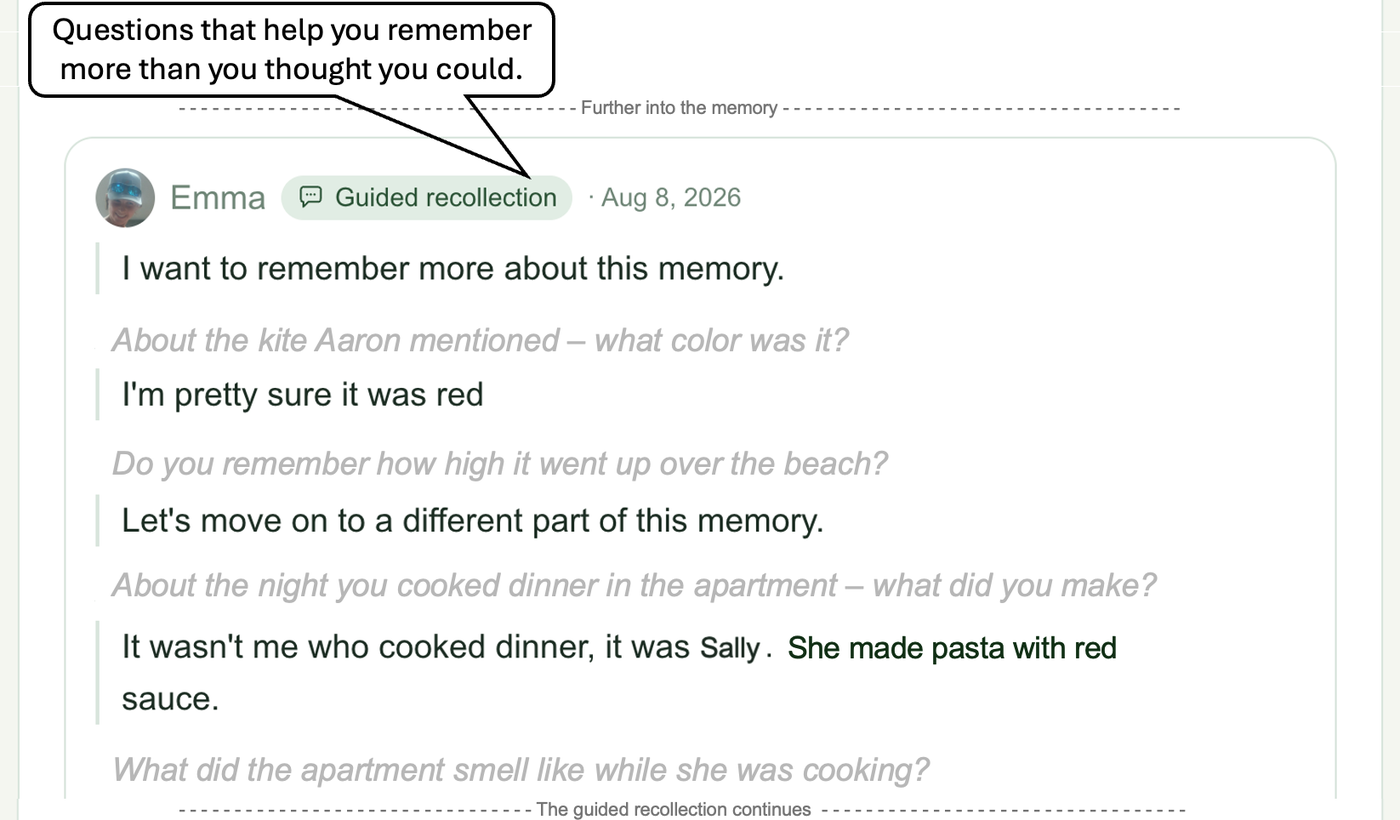
immemoris guides you back with questions — surfacing dates, places, sensory details, things you'd forgotten you knew. Most of a memory you can rebuild this way, on your own.
03
Bring in the people who were there — if it's shared
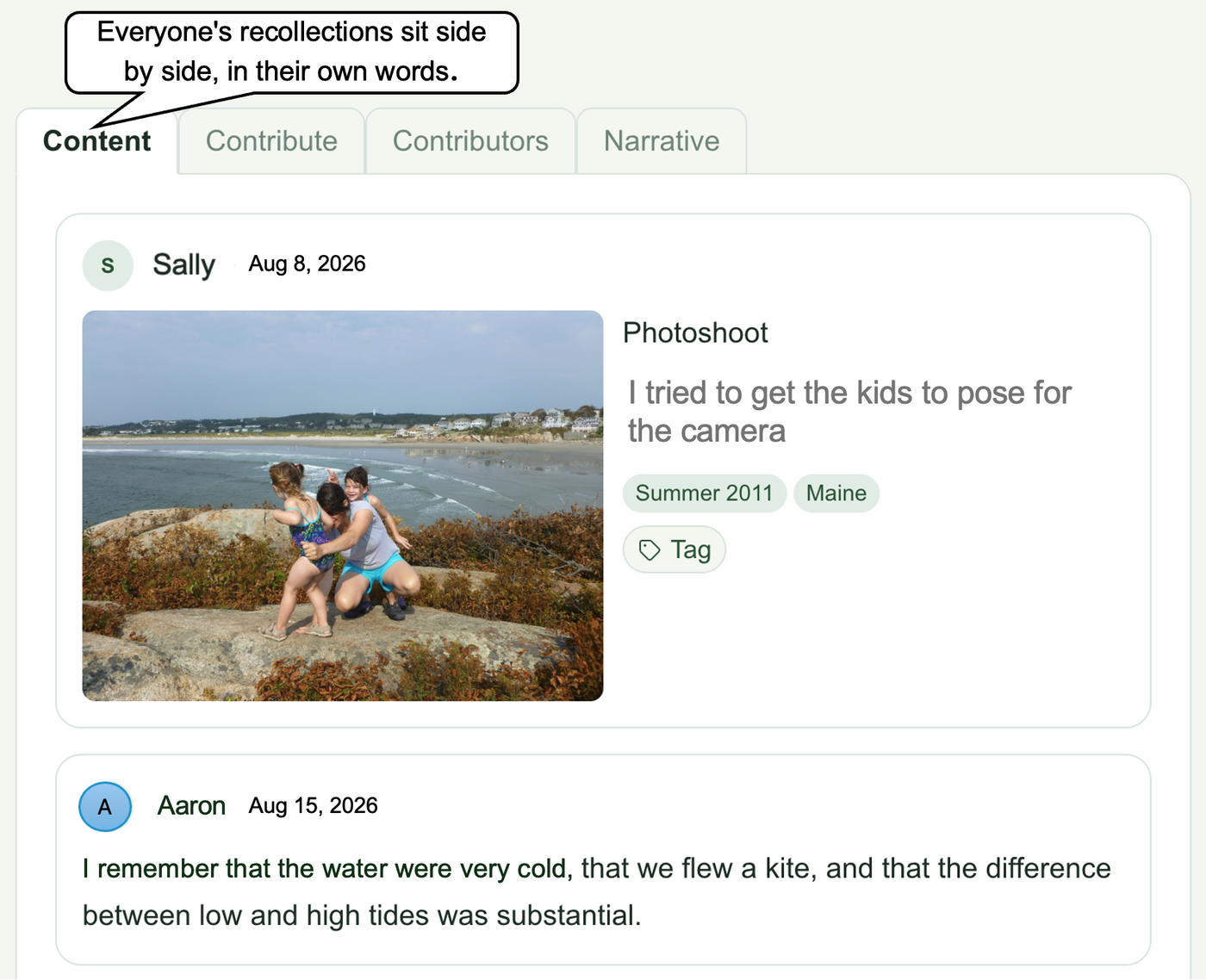
Some memories are held across several people. When yours is, invite anyone who was there; each adds what they remember, in text or photos. The pieces only you each hold come together.
04
Generate the narrative
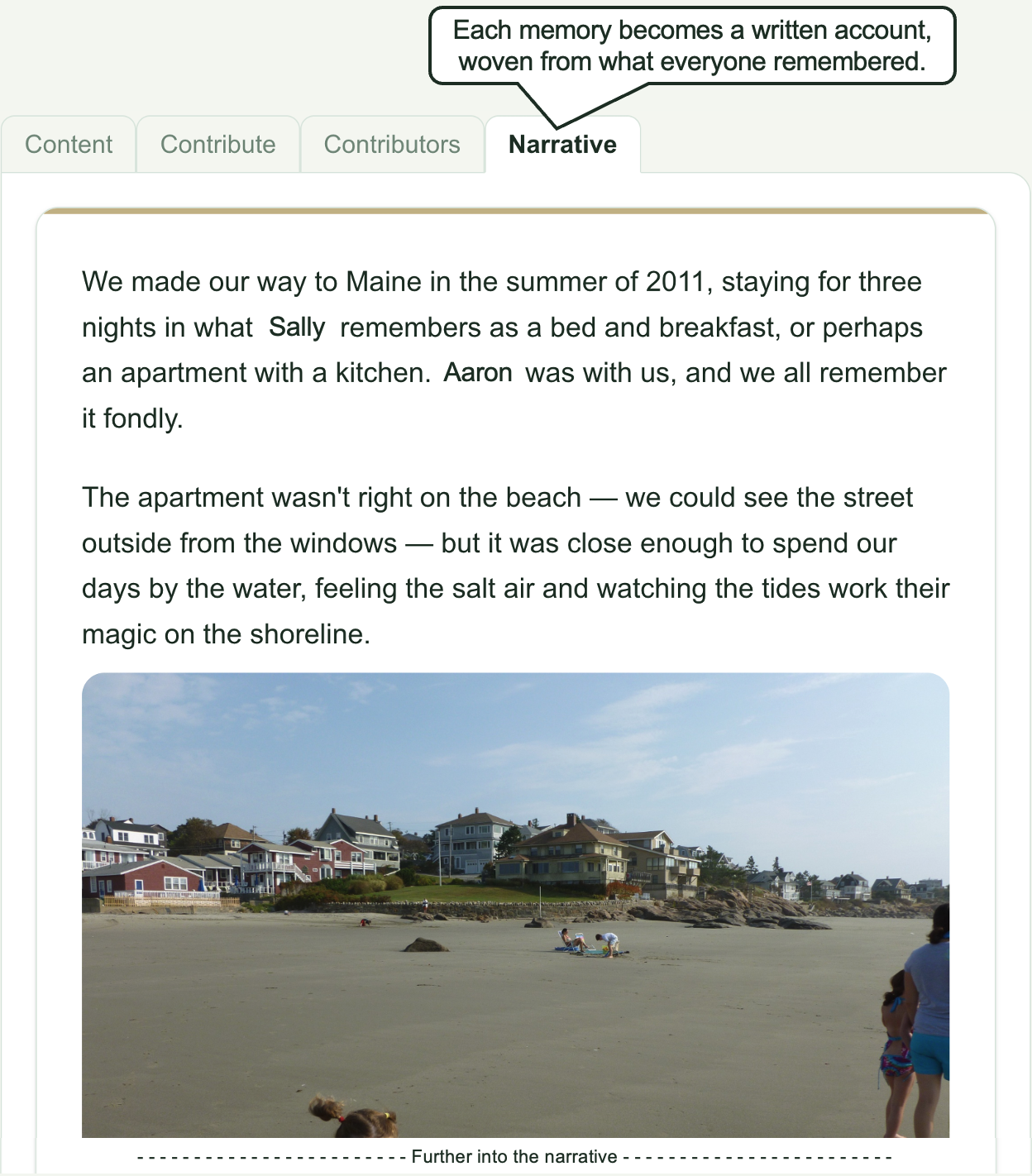
immemoris weaves the recollections and photos into a single written memory — in your own voice if it's yours alone, or first person plural if you built it together.
What a shared memory looks like
A memory you rebuild on your own becomes a narrative in your own voice. Harder to picture is what happens when several people reconstruct one together — so that's what we show here.
Contributors: Saggi, Dorit, Lia, Avi
We got up early and Dora and Avi took motion sickness pills, the whole nervous routine. By the first rapid the kids were already screaming... in the good way.
Was the guide Louis or Luis? I keep wanting to say Louis. Whatever his name was, he was hilarious — kept the whole boat laughing even when we got soaked. At one point he stopped so the kids could jump in. I wish I were that fearless.

Photo by Dorit
📍 Pacuare River · Jul 14, 2019 · 11:02am
I remember that at one point Louis stopped so the kids could jump in. I wish I were that fearless.
yeah, he made us do a trust fall backwards into the river!! it was so scary but also so cool

Photo by Lia
📍 Pacuare River, Turrialba · Jul 14, 2019 · 10:12am
i remember stopping by a waterfall and the guide painted patterns on me and Lia's faces. He had little rocks he rubbed between his fingers to get the colors — brown and red. I have no idea what they were. It looked like magic.

Photo by Avi
📍 Waterfall stop, Pacuare · Jul 14, 2019 · 11:47am
And then it was over. They pulled us out at a little shelter in the trees and laid out watermelon and pineapple and some snacks on a long table. we sat there dripping, eating fruit, watching the river keep going without us.

Photo by Saggi
📍 Rest stop, Pacuare · Jul 14, 2019 · 1:18pm
· · · 4 more contributions and 8 more photos · · ·
↓ immemoris weaves
Memory narrative
White-water rafting on the Pacuare
We set off early that morning — a couple of us had taken motion sickness pills just in case — but by the first rapid none of that mattered. The kids were already shouting, the boat was already soaked, and our guide, Luis (Louis to half of us, no matter how many times he corrected us), had a way of turning every near-capsize into a punchline.
At a calm stretch he stopped the raft and the kids jumped straight in. Then Luis had the rest of us do a backwards trust fall into the current — terrifying and exhilarating in equal measure, the kind of thing you only agree to because everyone else is doing it.
Later we pulled in near a waterfall. Luis painted Lia and Avi's faces with pigment he worked out of small river stones — reddish brown, faintly earthy. None of us know what the rocks were. Avi stood under the waterfall afterwards while the rest of us watched from the rocks, and for a long moment nobody said anything.

· · · narrative continues · · ·
Generated by immemoris from 7 selected contributions and 10 selected photos
Built for real memories
💭
Guided recollection
immemoris asks you questions to help surface details you might have forgotten — dates, places, sensory details, things others mentioned.
📍
Photo intelligence
GPS coordinates and timestamps from your photos help immemoris suggest which ones belong to this memory automatically.
🔒
Lock and preserve
When a memory is complete, lock it to preserve it exactly as it is. Contributors can still view it, but nothing can be changed.
✎
Edit the narrative
The generated narrative is a starting point. Edit it paragraph by paragraph, or roll back to a previous version with one click.
🎭
Narrative tone
Choose the tone that fits the memory — warm and nostalgic, celebratory, bittersweet, memorial, intimate, or spiritual.
🔔
Stay in the loop
Contributors are notified when a narrative is ready. A badge appears on your home page the moment a new narrative is available.
Pricing
Simple, transparent pricing.
Start free. No credit card required.
Free
$0
always free
✓ 5 memories you create
✓ Unlimited memories others invite you to
✓ 20 photos per memory
✓ 10 photos per narrative
✓ Unlimited contributors
✓ AI narrative generation
✓ Guided recollection
✓ Contextual suggestions
Plus
TBD
coming soon
✓ 25 memories
✓ 30 photos per memory
✓ No ads
✓ Everything in Free
Premium
TBD
coming soon
✓ Unlimited memories
✓ 60 photos per memory
✓ Video support
✓ No ads
✓ Everything in Plus
Pricing for Plus and Premium will be announced before the end of the beta. Free accounts will always remain free.
About immemoris
immemoris was born from a personal experience with aphantasia — the inability to visualize mental images. For someone who cannot picture a face, a place, or a moment they lived, memory is not something you can see. It is something you have to reconstruct from fragments: a word, a feeling, a photo, something someone else said.
That experience shaped everything about how immemoris works. Because it turns out that most people — with or without aphantasia — experience memory the same way: incompletely, partially, filtered through a single perspective. The difference is that most people don't know it.
immemoris is a tool for reconstructing shared experiences the way they actually happened — through multiple voices, multiple photos, multiple points of view. It is not a social feed or a photo album. It is closer to a shared journal that writes itself from everyone's contributions, and stays long after the details would otherwise have faded.
Some memories no longer have other reachable participants — a parent who passed away, a friendship that ended, a trip with people you've lost touch with. immemoris supports those too. A memory can be reconstructed over time, alone, as photos and details surface. The collaboration is simply with your future self.
The name carries two meanings: immemoris, Latin for forgetfulness or absence of memory — and a reminder that we are, in the end, the sum of our memories.
immemoris is patent pending.
Privacy & data
Your memories belong to you. Here's exactly what that means in practice.
Where your data lives
Text contributions, photos, and generated narratives are stored on Supabase (Postgres database and object storage, hosted on AWS). We use privacy-respecting analytics to count page visits — without cookies, without identifying you, and without tracking you across other websites. No advertising trackers, no behavioral profiles, and we never sell your data.
Who can see it
Only you and the contributors you explicitly invite. Memories are not public, not searchable, and not shared with anyone else. You can remove contributors or delete a memory at any time.
When AI is involved
immemoris uses Anthropic's Claude for two specific tasks — and only when you ask. When you click "Find relevant photos," your selected photos are sent to Claude to evaluate which ones likely belong to the memory. When you click "Generate narrative," the selected contributions and photos are sent to Claude to write the narrative. Nothing is analyzed in the background. Per Anthropic's API terms, your data is not used to train their models.
What we don't collect
We don't store your Google Drive or Dropbox login — each session you re-authenticate, and we only ever receive the specific files you pick. Our analytics are limited to anonymous, aggregate page-visit counts — we can't tie any activity to you as an individual.
For the full details, see the privacy policy.
FAQ
Is my data private?
Your memories are only visible to you and the people you explicitly invite. We may eventually show contextual suggestions — travel, experiences, or services matched to the themes of a memory you're viewing — but this matching would happen on our end, without sending any information about you or your memories to advertisers or third parties.
Who can see my memories?
Only you and the contributors you invite by email. Each memory has its own invite list. Contributors can view and add to a memory, but only the owner can generate narratives, manage contributions, or delete the memory.
How do I add a recollection?
Open a memory and type what you remember in the text box. You can also attach a photo from your device or from Dropbox, or record an audio recollection — your voice is transcribed automatically. immemoris can help you remember by asking guided questions based on what others have already shared and the photos already in the memory.
Can the narrative be read aloud?
Yes. The owner can click Listen on any narrative to hear it read aloud. Six voices are available — alloy, echo, fable, onyx, nova, shimmer — with different tones and feels. The owner picks the voice; contributors hear whatever the owner chose.
Can I mark how sure I am about a memory?
Yes. When adding a recollection, you can mark it as 'I'm sure,' 'I think,' or 'Not certain.' The narrative will reflect this — confident memories are stated plainly, while uncertain ones are hedged with phrases like 'we think' or 'the details have blurred.' Other contributors can also see your confidence level on each recollection.
What happens when contributors remember the same thing differently?
The narrative preserves the disagreement explicitly rather than choosing one version. So if one contributor remembers the trip as July and another as August, the narrative will say so — 'Sarah remembered the trip as July; Maya was sure it was August.' This also applies within a single contributor's own contributions — if you remember the same event two different ways across recollections, the narrative acknowledges the inconsistency. Memory is unreliable; immemoris is built to honor that rather than smooth it over.
Can I choose how the narrative reads?
Yes. You can pick the perspective — first-person plural ('we'), first-person singular ('I'), or third-person ('they') — and the tone (warm, celebratory, reflective, memorial, intimate, or spiritual). The default is first-person plural with a warm tone. Some memories work better as personal ('my own memory of Grandma'); some as collective ('our trip to Sicily'); some as observed ('the family gathered'). Pick what fits the memory.
How do I invite someone?
From any memory page, tap "Invite a contributor" and enter their email address. They'll receive an email with a link to join. Once they join, they can add their own recollections and photos.
How do I select which contributions and photos go into the narrative?
On the memory page, each recollection and photo has a checkbox. Select the ones you want included — up to 10 photos per narrative generation. The narrative will be generated from your selection.
Can I edit the narrative?
Yes — you can edit the narrative paragraph by paragraph. You can also use Arrange mode to drag paragraphs to a new order, move photos between paragraphs, or pull photos out into More Photos. If you regenerate and prefer the previous version, you can roll back with one click.
Can I manage or remove contributions?
Yes — as the memory owner, you can archive contributions (hiding them from the memory and narrative without deleting them permanently) or delete them entirely. Archiving is reversible; deletion is not.
What's the difference between archive and delete?
Archiving hides a contribution from the memory and narrative but keeps it in the system — you can restore it later. Deleting removes it permanently, including any photos attached to it.
Can I delete a memory?
Yes — as the owner, you can delete a memory entirely. This removes all contributions, photos, and narratives associated with it. This action cannot be undone.
Can I use immemoris alone, without inviting anyone?
Yes — though immemoris is built around collaborative memory, some memories don't have other reachable participants. A grandparent who passed away. An estranged family member. A trip with people you've lost touch with. In those cases, you can still use immemoris as a place to gather fragments over time — adding photos as you find them, recording details as they surface, letting the AI help reconstruct what you remember. The collaboration is just with your future self.
Can I transfer ownership of a memory?
Yes. As the owner, you can transfer ownership to any contributor on the memory. They'll need to accept before the transfer completes — you can also cancel a pending transfer before they act. After acceptance, you become a regular contributor and the new owner gains all owner privileges. We think of this as bequeathing a memory, useful for designating who manages it after you.
What are the limits?
During the beta, each memory supports up to 20 photos, and up to 10 photos can be used per narrative generation. You can select which photos to include. There is no limit on text contributions or the number of contributors per memory. Free accounts can create up to 5 memories of their own. There's no limit on memories others invite you to.
Is immemoris free?
Yes — and the Free plan will always be free, not just during the beta. We'll introduce optional paid tiers — Plus and Premium — with more memories, more photos, and no ads. We'll announce pricing well in advance of any change.
What happens to my memories if I stop using immemoris?
We're working on an export feature that will let you download your memories as a document. In the meantime, you can copy narrative text and download photos manually. We will never delete your memories without notice.
Start preserving what matters
The Free plan is always free. No credit card required.
Create your first memory